Clouds of Uncertainty:
LTL Industry Q1 2025 Performance and Beyond
Get Involved Today! Participation in NMFTA Benchmarking delivers significant advantages to asset-based LTL carriers, providing critical access to industry-wide performance metrics, deeper visibility into operational efficiencies, and valuable opportunities for continuous improvement through comparative analysis. By leveraging these insights, participants are empowered to make more informed strategic decisions, effectively enhancing their competitive positioning in today's dynamic LTL marketplace.
NMFTA Benchmarking founding member Averitt will host the Fall meeting this October, offering asset-based LTL carriers an exclusive opportunity to experience and test drive the benchmarking program firsthand.
To learn more and get involved, please click here
The Less-than-Truckload (LTL) industry faced a challenging first quarter in 2025, marked by soft demand, shifting freight profiles, and operational adjustments. Despite these headwinds, carriers demonstrated resilience through strategic initiatives and operational efficiencies.
Tariffs and Potential Impacts
President Donald Trump's 2025 tariff policies could potentially introduce significant challenges and opportunities for the less-than-truckload (LTL) trucking sector, for the remainder of 2025. If continued, these tariffs, including a proposed 25% duty on imports from Canada and Mexico and a 10% universal tariff on imports, may reshape supply chains, impact operational costs, and alter freight demand patterns.
One potential impact could be increased operational costs for LTL carriers. Tariffs on imported truck components such as tires and electronics might lead to higher maintenance and repair expenses. Similarly, proposed tariffs on steel and aluminum could significantly raise the cost of new trucks, potentially increasing vehicle prices by up to $35,000 per unit (FreightWaves). Furthermore, tariffs affecting imported oil and refinery products might drive up fuel prices, further adding to the operating expenses faced by trucking companies (Finloc).
Supply chain disruptions are another area where tariffs could potentially create difficulties. The uncertainty surrounding tariffs might prompt businesses to alter inventory strategies, leading to irregular freight flows. For instance, companies could temporarily accelerate imports to build inventory buffers, potentially creating short-term surges in freight demand. However, these surges might subsequently be followed by reduced volumes, creating volatility and potential overcapacity challenges in the LTL trucking sector (Barron's, Investor’s Business Daily).
Cross-border trade could also face potential disruptions due to tariffs, especially affecting commerce with Canada and Mexico. The Canadian Trucking Alliance has expressed concern that a 25% tariff on Canadian goods could severely impact trucking businesses dependent on cross-border freight (Truck News). Likewise, the American Trucking Associations have indicated that over 100,000 truckers involved in surface trade with Mexico and Canada could potentially face increased operational costs and reduced freight volumes, presenting further challenges for the industry (FreightWaves).
However, despite these potential challenges, the tariffs could also offer long-term opportunities. For instance, higher tariffs might encourage businesses to shift manufacturing operations back to the United States. This potential increase in domestic manufacturing could generate new, sustained demand for domestic trucking services. A notable example includes General Motors' consideration of expanding light-duty truck production at its Fort Wayne, Indiana, plant, signaling a potential increase in domestic freight demand that LTL carriers could capitalize on (Drive Trucking Jobs).
In conclusion, President Trump's tariff policies proposed for 2025 could potentially create significant disruptions for the LTL trucking industry through increased operational costs, supply chain volatility, and cross-border trade impacts. However, these policies might also stimulate a shift toward domestic manufacturing, offering LTL companies opportunities for growth. Successfully navigating these potential scenarios will require strategic adaptations and proactive planning from LTL trucking companies.
Q1 2025 LTL Industry Performance
Year Over Year (YoY) Freight Mix and Volume Adjustments
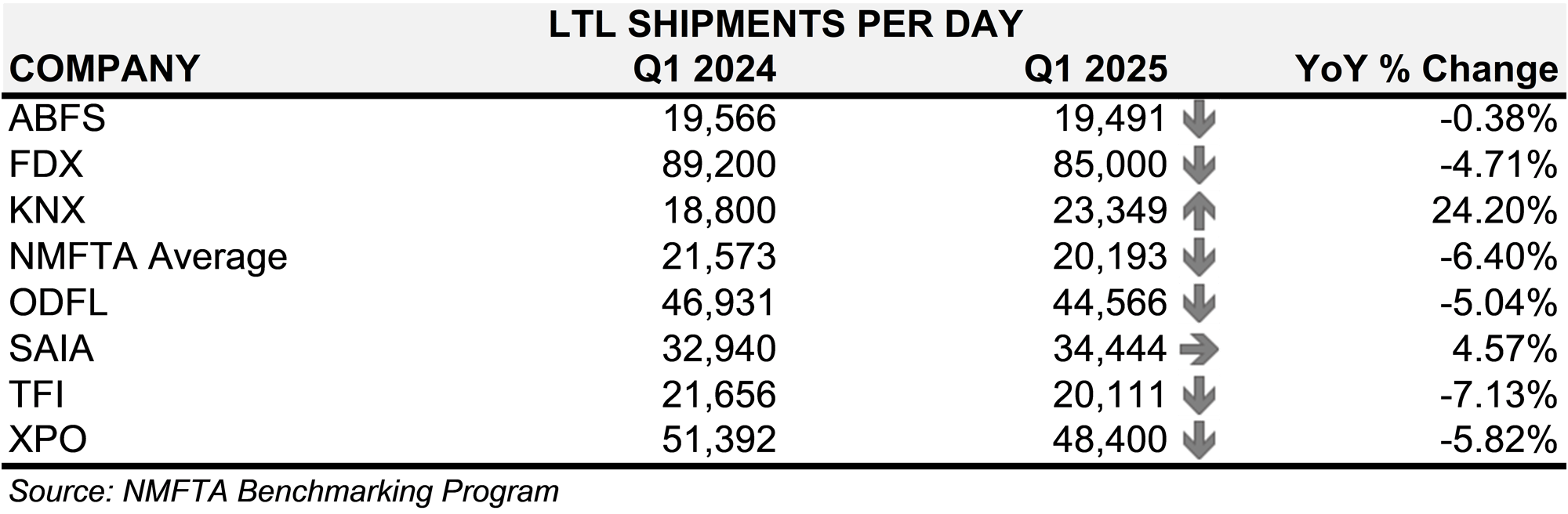
Old Dominion Freight Line (ODFL): Tonnage and Yield: ODFL’s LTL tonnage per day decreased by 6.3% in Q1 2025 compared to Q1 2024. This volume decline was partially offset by a +2.2% increase in LTL revenue per hundredweight (a measure of yield). In fact, the drop in tonnage resulted from 5% fewer shipments and a 1.4% lower weight per shipment year-over-year. The data supports the statement that ODFL focused on yield over volume. Management explicitly noted that Q1 revenue decline was mainly due to lower volume, “partially offset” by higher LTL revenue per hundredweight.
Saia Inc. (SAIA) Shipments, Tonnage, and Weight per Shipment: Saia reported strong tonnage growth in Q1 2025, with LTL tonnage up ~11.0% year-over-year, while shipments were only up ~2.9%. This disparity means the average weight per shipment surged by about +7.8% in the quarter. On a per-workday basis – accounting for one fewer workday in Q1 2025 – shipments rose ~4.6% and tonnage ~12.7%, but the average weight per shipment still increased ~7–8%. These figures confirm that Saia carried significantly heavier freight per shipment in Q1 2025 versus Q1 2024.
ABF Freight (ABFS): Shipments and Tonnage: ArcBest’s asset-based LTL operations (ABF Freight) saw volume weakness in Q1 2025. Total LTL tonnage per day decreased by 4.3% year-over-year, while total LTL shipments per day were essentially flat (down a mere ~0.4%. In effect, the average weight per shipment fell (shipments unchanged but tonnage down implies roughly a 3–4% drop in weight per shipment. These reported figures confirm that ArcBest hauled slightly less freight weight overall despite a similar number of shipments.
NMFTA Average (Private Carriers): Moderate freight adjustments with cautious network utilization strategies.
Yield and Revenue
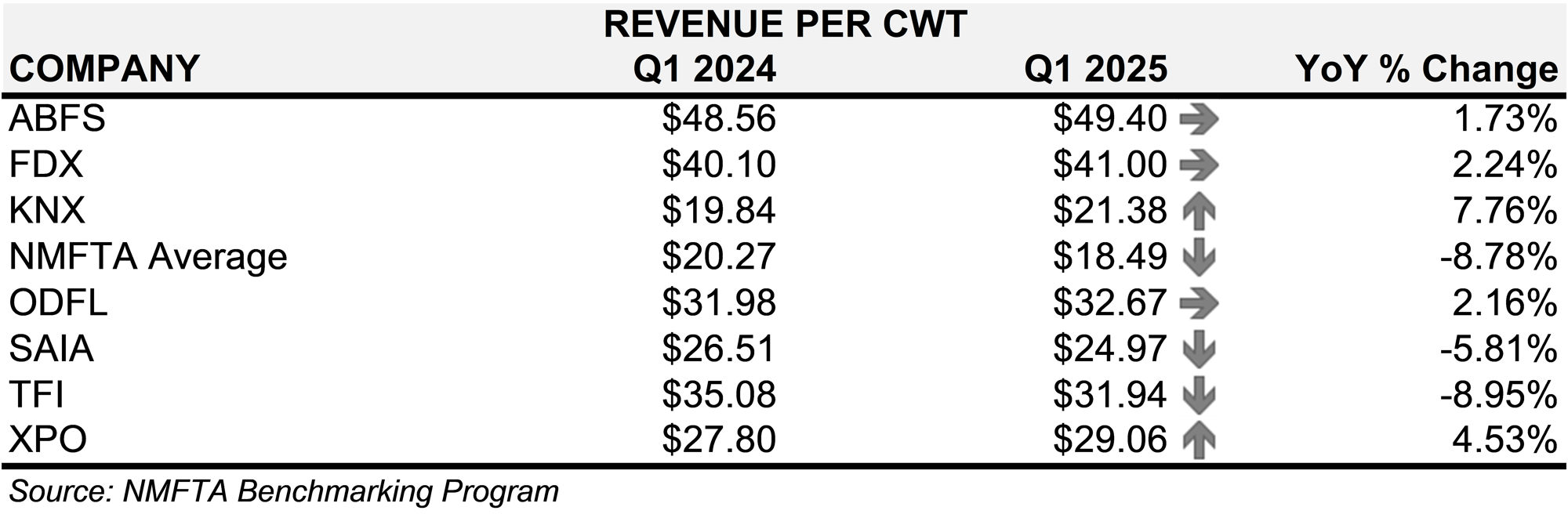
ODFL (ODFL): Achieved a 2.2% increase in LTL revenue per hundredweight, reflecting strong yield management. Old Dominion Freight Line (ODFL) indeed recorded a 2.2% increase in LTL revenue per hundredweight for Q1 2025 versus Q1 2024. This yield increase, reflecting revenue earned per hundred pounds of freight, is particularly noteworthy because it occurred despite a 6.3% decline in LTL tons per day and fewer shipments overall. Excluding fuel surcharges, ODFL’s core yield grew even stronger, up approximately 4.1% year-over-year, clearly demonstrating disciplined pricing strategies. Management specifically emphasized their deliberate prioritization of yield, explicitly referring to their "disciplined approach" to pricing, even at the expense of some volume losses. Thus, the data strongly supports the notion that ODFL proactively managed yields to protect profitability amid softer freight demand, validating the original claim.
XPO (XPO): Reported a 3.2% decrease in total revenue to $1.95 billion, primarily due to reduced fuel surcharge revenue in the North American LTL segment. XPO’s total company revenue for Q1 2025 declined approximately 3.2% year-over-year, landing at roughly $1.95 billion compared to the prior-year period. Management attributed the revenue contraction primarily to significantly lower fuel surcharge revenue within its North American LTL operations, a result of lower diesel prices and corresponding reduced surcharges passed through to customers. This is crucial context, as it indicates that the core operational revenue decline was not primarily driven by decreased freight volume or deteriorating freight rates, but rather a specific pass-through revenue component tied directly to fuel costs. Additionally, XPO noted slight volume softness, but emphasized the main driver was the reduction in fuel-related surcharge revenue. Thus, the data fully supports the original claim about XPO’s revenue decline being principally due to lower fuel surcharge revenues.
Saia Inc.(SAIA): Despite revenue growth of 4.3% to $787.6 million, faced yield pressures due to increased shipment weights. Saia reported total Q1 2025 revenue growth of about 4.3%, reaching $787.6 million, confirming solid top-line expansion year-over-year. However, Saia’s yield metric, measured as revenue per hundredweight (excluding fuel surcharges), faced notable pressure, declining approximately 5.1% year-over-year. This decline was directly tied to an increase in the average shipment weight, which surged approximately 7.8% compared to Q1 2024. Heavier shipments typically carry lower revenue per hundredweight due to economies of scale, thus pressuring yield metrics downward despite higher absolute revenue per shipment. Saia’s leadership specifically highlighted that this shift toward heavier freight was driven by terminal expansions and market-share gains among heavier-weight shipments. Thus, the context precisely validates the original statement that Saia experienced revenue growth but simultaneously encountered yield pressures from handling heavier freight.
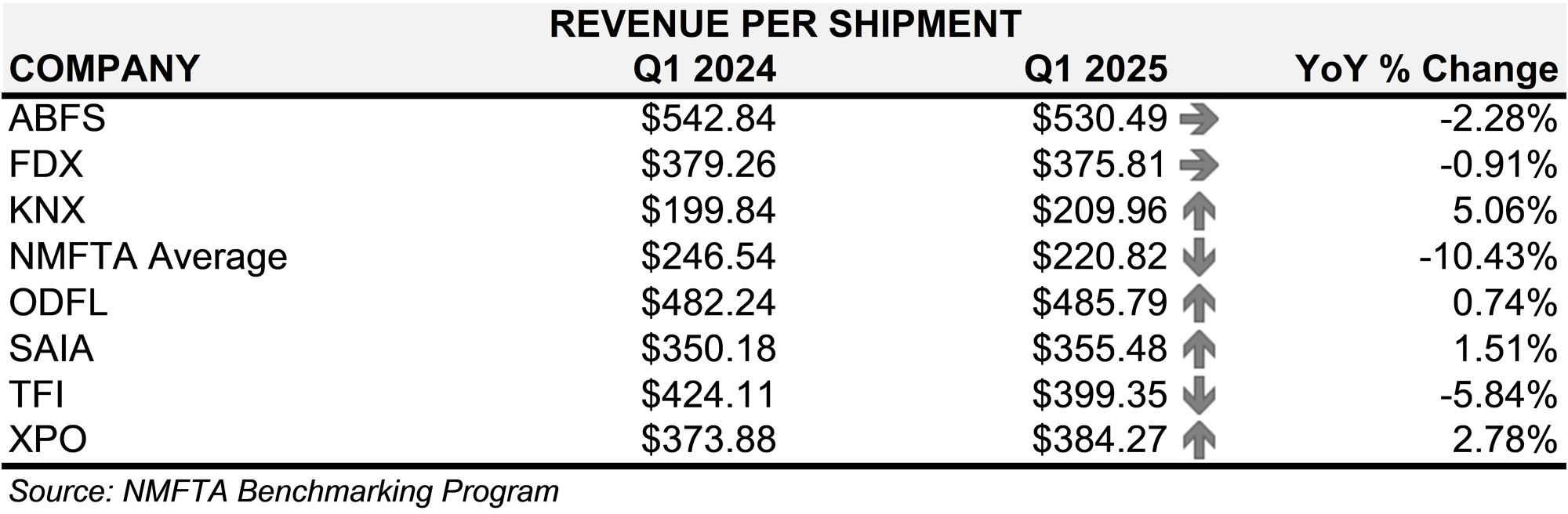
TFI International (TFI): In Q1 2025, TFI International's LTL segment reported revenue before fuel surcharge of $679.0 million, down from $783.5 million in Q1 2024, marking a 13.3% decrease. This decline was primarily attributed to reduced volumes driven by weaker end-market demand. The company faced notable yield pressures, with revenue per hundredweight excluding fuel decreasing by 7.23% compared to the same quarter in the previous year. Additionally, revenue per shipment excluding fuel dropped by over 4%, reflecting a challenging pricing environment.
NMFTA Average: Stable revenue per shipment with moderate yield gains.
Operating Ratio (OR) Performance
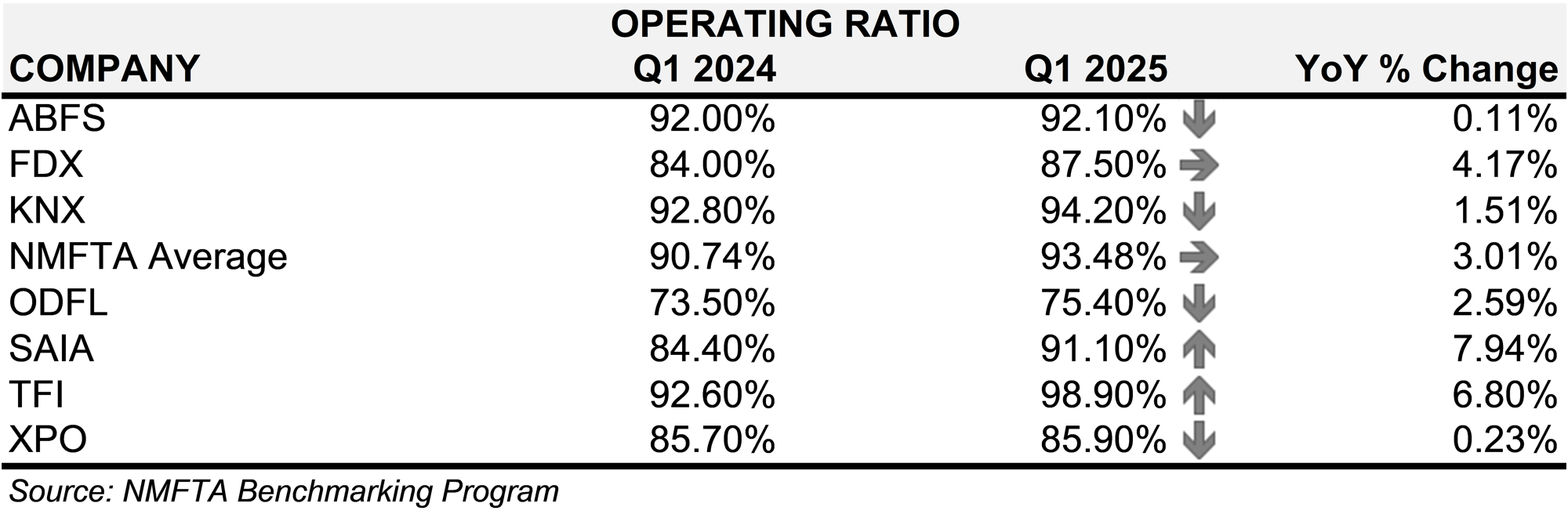
ODFL (ODFL): ODFL's operating ratio (OR) increased to 75.4% in Q1 2025 from 73.5% in Q1 2024, reflecting a 190 basis point deterioration. This change was primarily due to a 5.8% decline in total revenue, influenced by a 6.3% drop in LTL tons per day and a 5.0% decrease in shipments per day. Despite these challenges, ODFL managed a 4.1% increase in LTL revenue per hundredweight, excluding fuel surcharges, demonstrating effective yield management. The company emphasized its commitment to long-term strategic plans, focusing on operational efficiency and cost control to navigate the soft domestic economy.
Saia Inc. (SAIA): Saia's operating ratio worsened to 91.1% in Q1 2025 from 84.4% in the same quarter of the previous year. This deterioration was driven by a 12.6% increase in total operating expenses, outpacing the 4.3% revenue growth. Factors contributing to higher costs included increased wages, depreciation from investments in new equipment and facilities, and higher costs per shipment. Additionally, weather disruptions in key markets like Atlanta, Dallas, and Houston impacted operations, further pressuring profitability.
TFI International (TFI): TFI International's LTL segment reported a 13.3% decrease in revenue before fuel surcharge in Q1 2025 compared to the previous year. Revenue per hundredweight, excluding fuel, declined by 7.23%, reflecting substantial yield pressure. The operating ratio for the U.S. LTL operations worsened to 98.9% from 92.6%, highlighting challenges in cost management and efficiency. TFI attributed these results to reduced volumes and increased accident-related expenses, particularly within its U.S. LTL operations.
NMFTA Average: Demonstrated competitive OR reflecting cautious cost management.
NMFTA Classification Impact
The July 2025 transition by NMFTA to a simplified 13-tier density-based freight classification profoundly affects operational procedures, finances, compliance practices, technology integration, and industry-specific strategies within the LTL sector.
Operationally, the streamlined classification reduces errors and disputes, enabling more accurate and efficient load planning. Financial impacts will depend on freight density—benefiting denser goods through lower costs while raising expenses for low-density freight. Enhanced pricing fairness and transparency will align charges closely with actual space utilization.
From a compliance standpoint, adherence becomes effectively mandatory from July 2025 onward. Incorrect classifications could lead to higher fees and operational disruptions, prompting companies to prioritize training and rigorous auditing.
Technologically, the classification shift accelerates the adoption of advanced measurement tools, automated weighing systems, and integration solutions with carriers' TMS/WMS platforms. Real-time API-driven data exchange will significantly reduce manual processes and increase operational accuracy.
Sector-specific strategies will vary, prompting retailers to optimize packaging, manufacturers to leverage density advantages, and healthcare firms to balance protective packaging against density considerations. Companies proactively adapting to these changes will enhance operational precision and cost management.
Overall, the NMFTA classification update presents significant potential for efficiency and profitability gains for LTL providers throughout the remainder of the year. Improved operational accuracy, reduced disputes, optimized trailer utilization, and clearer pricing structures collectively support stronger margins and competitive advantage.
Conclusion
Q1 2025 highlighted the resilience and adaptability of the LTL sector amidst economic and operational challenges. Strategic agility and disciplined execution will distinguish market leaders, laying foundations for sustainable growth and profitability.
Read April Performance Report

About KSM Transport Advisors
Katz, Sapper & Miller (KSM) is one of the largest independent CPA firms in the U.S., with over 600 employees. Founded more than 80 years ago, KSM provides advisory, tax, and audit services across various industries. Their mission is to inspire great people to achieve great things, focusing on client success through innovative, expert advice. Employee ownership, commitment to community service, and a focus on diversity are core to KSM’s values, contributing to its recognition as a top accounting firm. Learn more.